I've learned to mistrust books described as "coming of age story".
This is mostly because they are all, essentially without exception, absolutely depressing as hell. And Kicking the Sky by Anthony De Sa is no different.
Now sometimes things are depressing, especially when you're a teenager. And sometimes things are good. And sometimes there are books like this one, and like Catcher in the Rye, where nothing good EVER happens to the protagonist. As opposed to a more balanced and realistic story where good things occasionally happen (as they do in real life, even if your life is really shitty), like The Perks of Being a Wallflower. And I know that's because the writer would like us to feel the depth of their angst, but really it just serves to make the book unrelatable and unpleasant to read. The lack of any redeeming moments or characters is what makes Kicking the Sky into a long, drawn-out, masochistic bore.
So why did I pick up Kicking the Sky knowing what type of book it was? The premise involving a murder as the catalyst of loss of innocence was very intriguing, especially a real-life murder. But this event is hardly mentioned at all in the middle section of the book, almost as if the author forgot about it while he was busy writing about all the terrible things that happened to everyone. Considering the main characters are 11- and 12-year-old boys, there's lots of sex (most of it non-consensual) and drug use, assaults, and dead people that nobody seems to mind too much about. I get that they are supposed to be neglected latch-key kids, but somebody's getting raped or molested in some way in pretty much every chapter. It was totally unnecessary. We got it the first umpteen times, their lives are shitty and they're exposed to a bunch of crap they shouldn't be. Which makes me question whether they had any innocence to lose to begin with, and whether protagonist Antonio can actually be pining for a childhood that didn't really exist to begin with. So the story also falls short on that account as well, as I can hardly assume that Antonio's family suddenly woke up one day as terrible people after a childhood supposedly full of happiness.
Usually I like to build a "compliments sandwich" for my book reviews, where I talk about what I liked, then talk about the parts I didn't, and then end with something positive. But I'm just not sure I can with this one. It's not a dramatic story about growing up, it's just a bunch of terrible things happening to people over and over and over, with no happy moments to break up the action and create realism. Give this one a pass.
Showing posts with label sadness. Show all posts
Tuesday, 6 May 2014
Monday, 16 September 2013
When subject matter gets serious: a pair of book reviews
While I like to consider myself a "jane of all genres", I have often been diagnosed as a great reader of adventures and comedy.
However, this past week I found myself keeping company with two VERY heavy, emotional and deeply saddening works of fiction. This was unusual for me not because the books were sad (call me a cold-hearted bitch but I really do enjoy a good unhappy ending), but because I will rarely follow a heavy, emotional book with a second book of the same nature. I typically like to break them up and intersperse some lighthearted children's works or maybe a cute graphic novel in between these emotional heavyweights. Just for the sake of my emotional health, and my supply of tissue.
But without further ado, I present the two reviews. The first is a classic of Russian fiction and criticism of Stalinist repression; the second is a work of YA fiction that forces the reader to confront their deepest fears.
One Day in the Life of Ivan Denisovich by Alexander Solzhenitsyn
This book was my pick for book club this month, for which our selected genre was fiction in translation. I have developed a great love for mid-20th century Russian fiction and satire due to the wonderful, insightful writings of Mikhail Bulgakov. Beyond his most widely read The Master and Margarita, Bulgakov has a substantial list of works which were not published until long after his early death, due to his overwhelming criticisms of life in the Stalin-ruled USSR. With Bulgakov as the foundation for my experience of Russian literature, I had some expectations going into One Day. And all of my expectations were met and greatly exceeded. One Day takes the reader into the bitter, unmerciful world of a Soviet prison camp through the eyes of Ivan Denisovich Shukov, a former soldier who is imprisoned after being accused of going AWOL. By the time the reader is introduced to Ivan, he has already been incarcerated for several years. Solzhenitsyn spares nothing in his description of camp life, from Ivan's rejection at the medical facility to the meagre meals and bitter cold in which the imprisoned men are forced to work. But the part that really hits the reader square in the gut and conscience is how grateful Ivan is that this day of his is a particularly good one. He is so thankful that he managed to stay out of solitary confinement and received an extra tiny piece of black bread. The last few pages of this book describe how Ivan drops off to sleep in a state of contentment. This is so difficult for the reader to digest after reading the descriptions of all the awful abuses of camp life. The contrast pulls on the emotions and adds even more to the reality of the experience and the appreciation of those awful circumstances that Solzhenitsyn instills in the reader. Overall, this book was a difficult read due to the all too true descriptions and subject matter of the work, but absolutely worth reading.
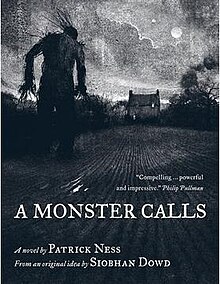
A Monster Calls by Patrick Ness
Having read Patrick Ness' Chaos Walking triology, I also had expectations when approaching A Monster Calls, which I had been meaning to read for a very long time. A Monster Calls is just so incredibly different from Ness' other work, I quickly disregarded what I remembered from those books and looked on this one with fresh eyes. In this disturbing teen read, a 13-year-old boy is visited by a monster which forces him to confront the disturbing realities of his life. And I can't tell you anymore than that without completely spoiling the book, which I wouldn't want to do because EVERYONE should read it. Books don't often make me cry, but this one had me darn close at the end. The writing is lyrical even though it is told from a 13-year-old perspective, and the accompanying illustrations are perfectly suited to the tone of the story. The story is simultaneously beautiful and horrifying, it is truly a unique work of fiction which conquers very difficult subject matter without being trite or melodramatic. The message of the story is incredible, and I very honestly would recommend this book to anyone who is capable of feeling feelings, because A Monster Calls will make you have so many of them.
So after all that strenuous emotional reading, what am I reading now? I'm working on some non-fiction reads on information consumption for an online course I'm taking. Talk about switching gears!
Ciao for now.
Subscribe to:
Posts (Atom)